Sake and Its Cousins: A Family Divided by Fire
Rice gives rise to an entire family of Asian drinks, yet they could hardly taste more different from one another. The dividing line comes down to a single decision in the production hall.
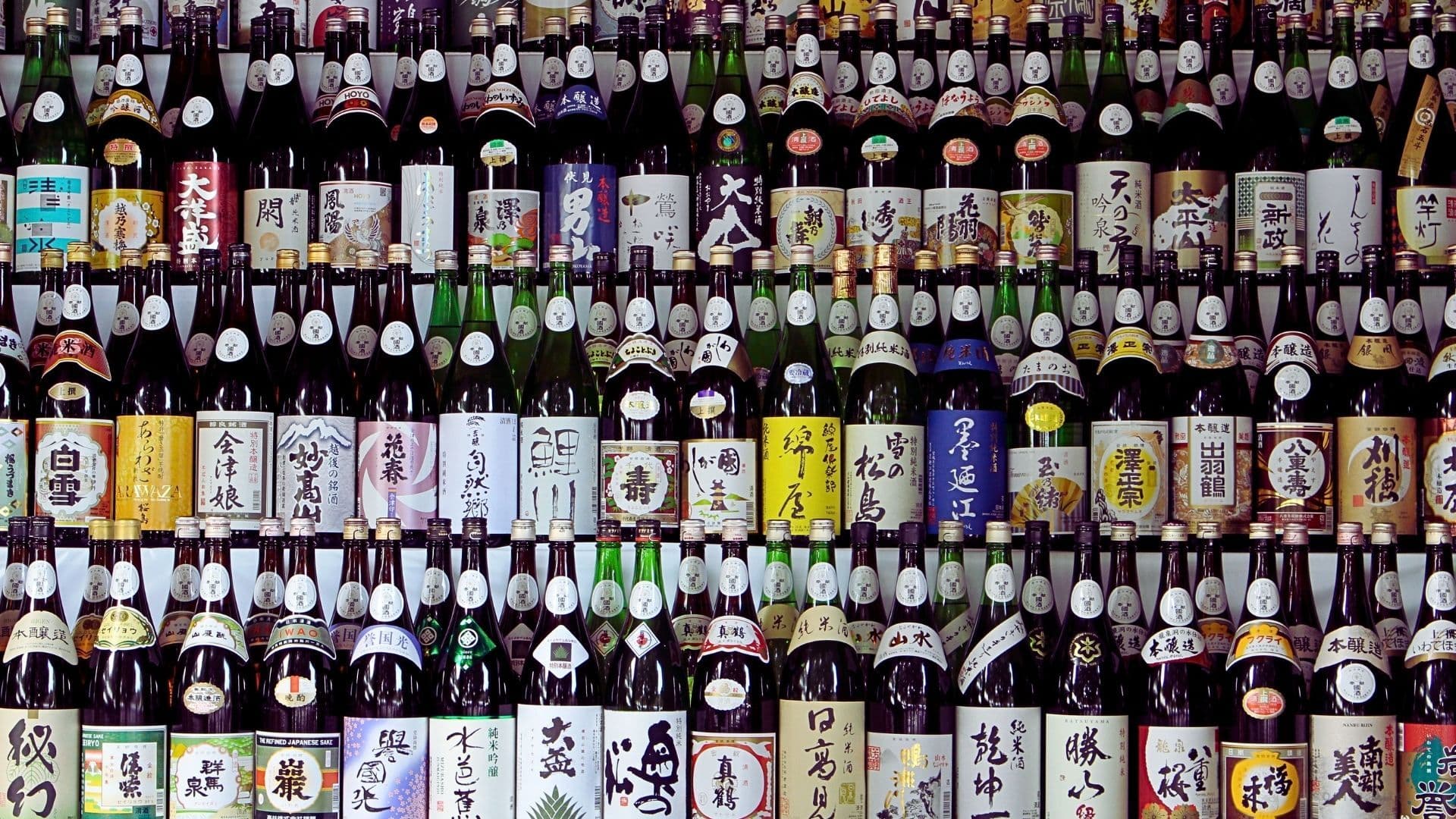
Most people meet sake first, and many never go further. It arrives at the table in a small carafe, warmed in winter or chilled in summer, and that one encounter comes to stand in for the drinking traditions of an entire region. Sake has earned its place as the introduction. It is graceful, easy to pair with food, and now poured on serious wine lists from Tokyo to New York. Yet it is only the front door to something much larger, a broad group of related drinks that outsiders tend to bundle under a single vague label and seldom stop to tell apart.
Sake, shochu and awamori are connected by rice, koji and centuries of Japanese fermentation knowledge, but they belong to different beverage categories.
That habit of bundling them together sells the whole group short. Korean soju, Japanese shōchū, Okinawan awamori, and a scattering of rustic country brews all share a thread of rice and a common ancestry, and yet they part ways on geography, base ingredient, strength, and, most of all, method. A single choice made early in production, one that rarely gets much attention, sends these drinks down two completely separate roads. Once you learn to recognize that choice, a shelf full of unfamiliar bottles stops looking like a wall of mystery and starts to read like a map.
The Common Root Beneath It All
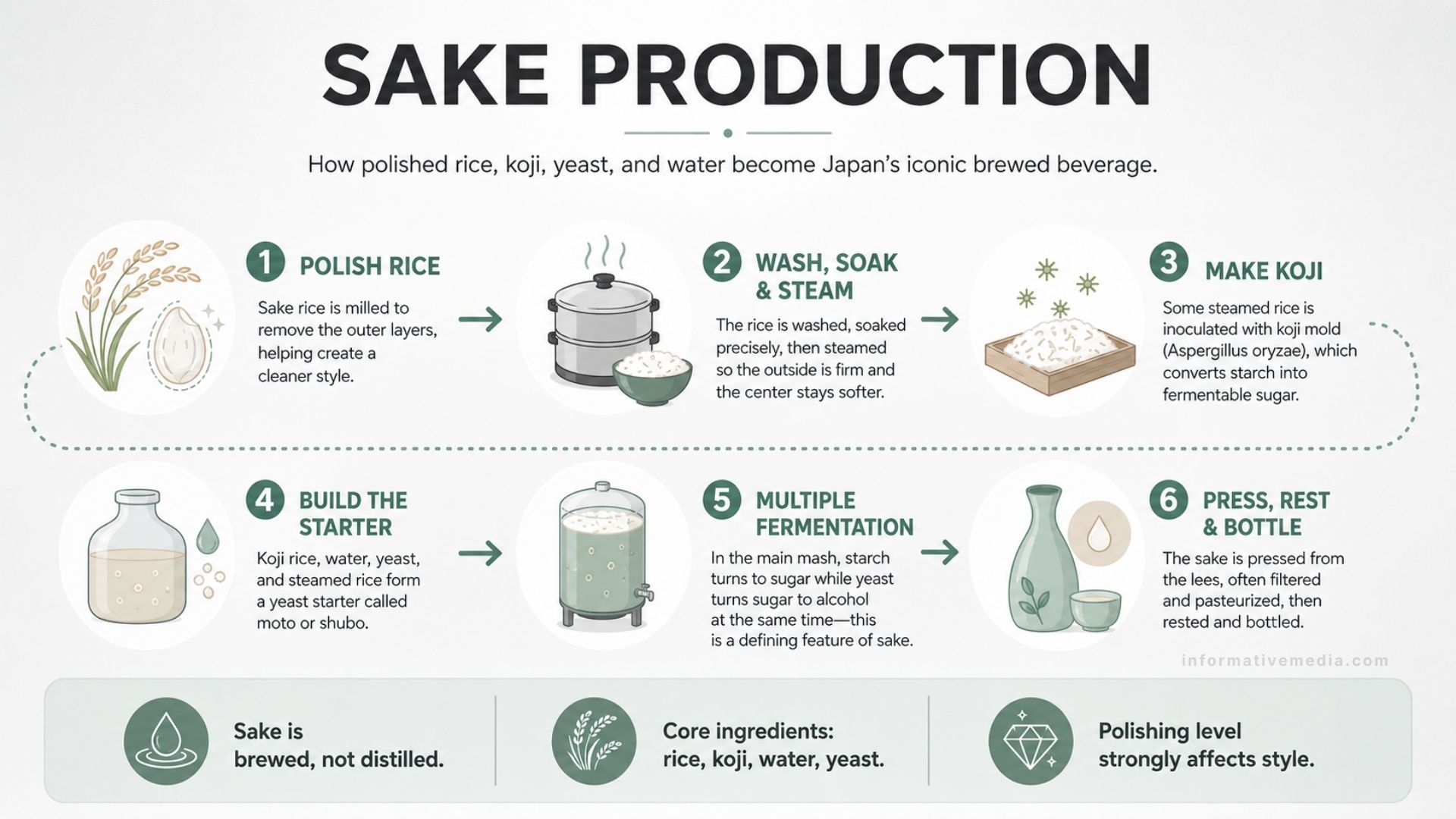
Before any of the differences, there is a shared secret, and it is the thing that makes sense of everything downstream. Western brewers turn grain starch into fermentable sugar by malting, coaxing barley to sprout. East Asia solved the same problem another way, by recruiting a cultivated mold to do the work instead. In Japan that mold is called kōji, in Korea it grows inside a starter cake known as nuruk, and in China it is qū. This one biological move is the ground on which the whole tradition stands.
Sake shows the technique at its most exacting. Brewers first mill the rice, grinding away the outer layers that carry fat and protein to reach the starchy heart of the grain, called the shinpaku, and how far they go sets the grade. What happens next is the step that separates sake from every Western brewing tradition. The kōji turns starch into sugar at the very same moment that yeast turns that sugar into alcohol, both reactions running side by side in one tank. This parallel fermentation belongs to sake alone and pushes it to roughly fifteen or sixteen percent alcohol on its own, well beyond what beer or most wine reaches through fermentation.
One Fork, Two Families
Here the paths divide. Sake is brewed, and like anything brewed it stays modest in strength and keeps the delicate aromas that fermentation builds. Its grades all trace back to that early milling. A junmai contains nothing but rice, water, kōji, and yeast, and tends toward savory, earthy depth, often poured warm. A ginjo mills the rice down to sixty percent or less of its original size, and a daiginjo to fifty percent or less, both yielding lighter, more fragrant sake usually served well chilled.
The rest of the group walks through the other door, distillation, and comes out changed. Shōchū, Japan's own distilled spirit, is usually distilled a single time to hold on to the character of its base, which may be rice but is just as likely sweet potato, barley, or sugarcane, landing near twenty-five percent alcohol. Awamori, the pride of Okinawa, starts from long-grain Thai rice and a black kōji, then often rests in clay urns to soften into an aged style called kūsu. Korean soju once came from rice in the same fashion, though most inexpensive modern bottles now lean on diluted neutral alcohol. Distillation sheds weight and raises proof, turning out something far cleaner and hotter than any brewed drink.
What Reaches the Palate
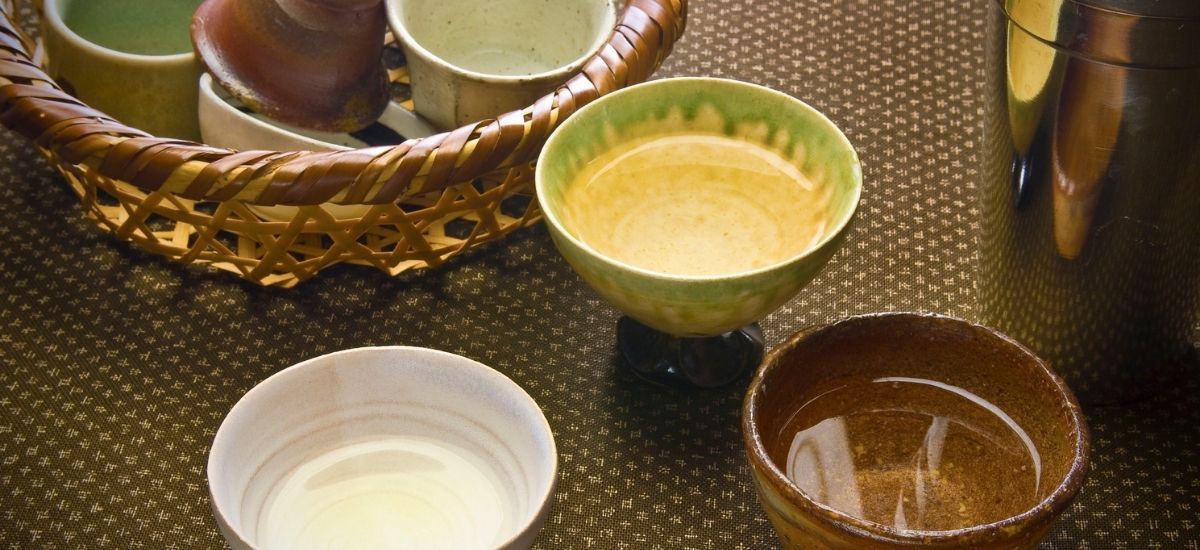
All of this lands as a spectrum of experiences wide enough to defy any single summary. At one end sits premium sake, poured cold into a wine glass, giving up notes of melon, pear, and white flowers at a low and gentle strength that suits slow sipping. It sits at the table much like a fine white wine, matching sashimi or other light dishes and asking to be compared and considered rather than knocked back.
At the other end wait the distilled relatives, each built for its own kind of evening. Shōchū bends to almost any setting, taken over ice or cut with hot water as the weather dictates, its flavor turning on whatever it was made from. Awamori runs deeper and funkier, especially with age, rewarding drinkers who go looking for that earthiness. Soju is light, clean, and sociable, the easy companion to a Korean dinner. Further out sit still other kin worth knowing, among them cloudy, tangy makgeolli, an unfiltered rice brew of just six to eight percent that holds down the rustic, farmhouse corner. Each suits a different occasion, mood, and appetite.
Sake, shochu and awamori demonstrate how fermentation and distillation can transform similar raw materials into completely different beverages.
The Takeaway
The thing worth carrying away is a single question to ask of any of these bottles: was this brewed and left alone, or distilled and concentrated? That one distinction predicts almost everything that matters, the strength in the glass, the weight on the palate, whether the drink wants a wine glass or a tumbler, and whether it belongs beside a meal or after one. A grain as ordinary as rice can end up as a soft, aromatic drink for lingering over or as a sharp, high-proof spirit for mixing, and the drinker who knows which fork was taken is never truly lost in front of an unfamiliar label.
That matters more now than it used to. These drinks are no longer confined to specialist importers and diaspora restaurants. Shōchū, soju, and their relations are turning up on Western back bars and store shelves at a pace that would have seemed unlikely a decade ago. Sake did the early work of teaching the world to take Asian fermentation seriously, and it remains a fine place to begin. The more interesting territory lies just past it, in the cousins that sake's fame has kept in partial shadow. They carry their own histories, their own regions, and their own reasons for tasting the way they do, and they reward anyone willing to look beyond the one name they already know.
Frequently Asked Questions
Is sake a rice wine?
The comparison is understandable, but sake is technically its own type of brewed beverage. Unlike wine, where grapes already contain fermentable sugar, rice contains starch that must first be converted into sugar by koji before yeast can produce alcohol.
What is the difference between sake and shochu?
Sake is brewed and usually sits around 15 percent alcohol, while shochu is distilled and commonly bottled at significantly higher strength. Shochu may also be made from ingredients other than rice, including barley, sweet potato and buckwheat.
What is awamori?
Awamori is Okinawa’s traditional distilled rice spirit. It uses rice koji made with black koji, a whole-koji fermentation method and pot distillation, giving it a production identity distinct from both sake and many other types of shochu.
Is shochu always made from rice?
No. Shochu can be produced from rice, barley, sweet potato, buckwheat, black sugar, sake lees and other approved ingredients. The raw material plays an important role in determining the finished spirit’s character.
What does koji do?
Koji produces enzymes that convert starch into sugar, allowing yeast to ferment grain-based ingredients into alcohol. It can also influence aroma, flavor and amino-acid development.
Why does awamori use black koji?
Black koji generates substantial citric acid, helping suppress unwanted microbial activity during fermentation. This proved especially useful in Okinawa’s warm and humid climate.
Can sake, shochu and awamori be aged?
Yes, although aging traditions differ. Sake can be enjoyed young or aged, shochu may be matured in tanks, ceramic vessels or barrels, and aged awamori has a particularly important tradition under the name kusu.